What I am Reading Now…
Adam HajYahia
August 2026
To read in this moment of imperial warfare and planetary crisis feels like a luxury. Not simply because it requires having the time outside of the demands of labor, but for mustering the capacity to make the necessary space for quietude of the emotive and thoughtful; the conditions that allow one to dive deep into other worlds and the situations of peoples deemed other— to dive deep enough to forgo the dominating predicaments that contour one’s subjective present. Yet to remain exclusively preoccupied with the forces of the present is itself a form of surrender: a subscription to narratives that demarcate what is happening here from what has happened here and elsewhere. It is an act of isolation that renders one’s sight fixed only on the immediate, overlooking all else that makes the immediate what it is, what makes the immediate possible, what is made possible by the immediate. To read, then, must always be with the help of more than an eye or two, with lots in sight near and at a distance, so it can never become a reading as a diversion from the exterminatory present and its immediacies, but an engagement with the present against its own overdetermined terms. To read in the present must become a reading against the present and what it continuously homogenizes, by bringing the dead and the unborn into the now, placing their displacement.
To read is a humble act, far from resistance but a little bit more than paralysis, as it can unfold in between the temporalities of the immediacy of death and life’s mediation. To be sure, reading is merely an attempt to search for another temporality that is different from the one imposed by the event of killing, where the dead may become subjects only after their lives have been shattered to pieces. To read is to read against the temporality of the law and the time of explosions and bullets that organize the moral and juridical collective inside the lines that mark the site of the dead body in the scene of what becomes a crime only after life has been taken.
Some people read together in the site of struggle and death, as they implement their interpretations of the written word by tearing down hospital walls in humble revolutions against the reparative.[1] Some read the neglected texts of others in an effort to breathe new sounds and meanings into words many refuse to hear.[2] Some read with the dead, to shake up the living outside of the violence they call life, so that one day it becomes a life worth living.[3] And some write words meant to be only read aloud,[4] and others read with the conviction to account for the weight of each and every word written in vain.[5]
Reading
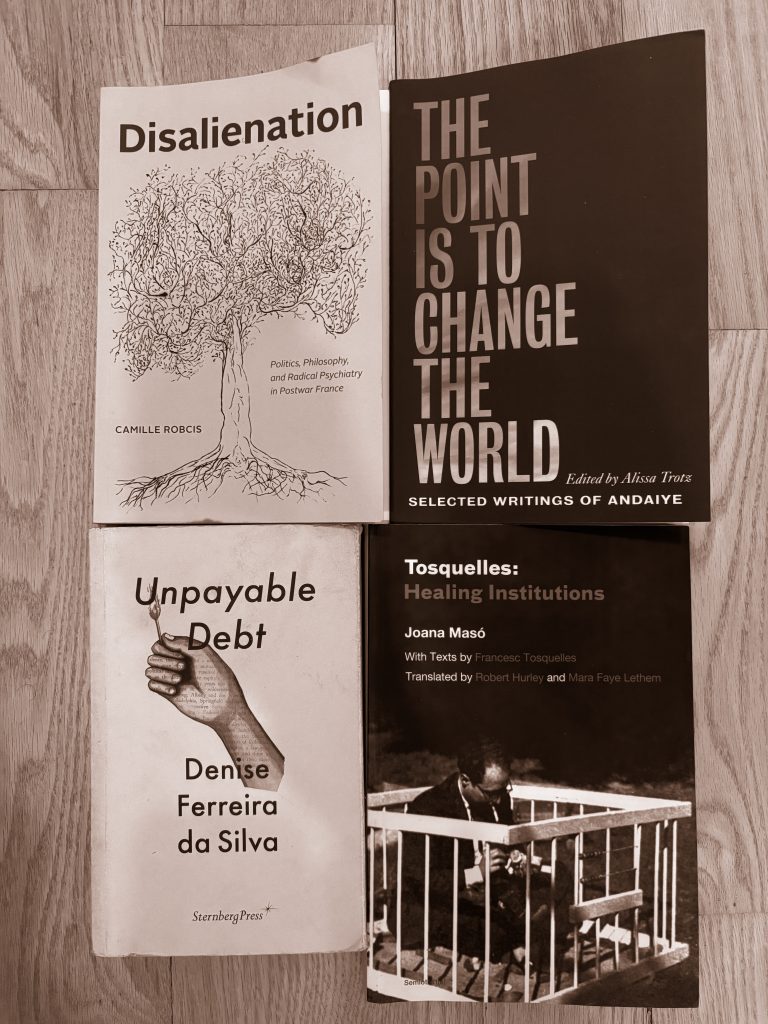
[1] Tosquelles: Healing Institutions, Joana Maso, trans. Robert Hurley, Mara Faye Lethem (2026)
[2] Focault in Iran, Behrooz Ghamari-Tabrizi (2026)
[3] The Point is to Change the World: Selected Writings of Andaiye, ed. Alissa Trotz (2020)
[4]الأعمال الشعرية – معين بسيسو ١٩٤٦-١٩٦٦
(Muin Bseiso – The Complete Works: Poetry 1946-1966)
[5] Unpayable Debt, Denise Ferreira da Silva (2022)
Please note the views published in What I am Reading Now… are personal reflections of the contributors.
These may not necessarily represent the views of the University of Dundee.
———
Previous Issue: Black Waters, July 2026
Next Issue: Naeem Mohaiemen, September 2026
