What I am Reading Now…
Viola Yeşiltaç
December 2025
Throughout the past couple of years, while trying to understand my artistic practice better—by asking myself what keeps me going despite the hurdles we face—I have come to see it less as a search for an origin point for ideas and more as a willingness to let the process unfold on its own. This openness resonates with the way I have been living these past three years. I rarely stay longer than a few months in one place, yet I never lose sight of Germany. Often in transit, adapting, and navigating shifting contexts. Migration and movement recur throughout my experience and are interwoven into my artistic practice.
I remain invested in processing Germany’s recent past and observe the gradual shifts in its cultural and political landscape, as well as its ongoing neglect in cultural institutions towards citizens with migrant backgrounds. In Germany, it is common to refer to people with migrant backgrounds as Menschen mit Migrationshintergrund. In colloquial terms Kanake or Kenek, are more familiar (though of derogatory nature).
Whether in the fine arts, literature, film, dance, or music, representation and support have long been limited. And when “migrant” voices are acknowledged, it is often through a narrow lens of identity politics that confines rather than liberates, limiting access to a genuine sense of artistic freedom.
Throughout the pandemic, I read mainly German authors with “migrant” backgrounds. Their stories are diverse, rooted in personal experience, and I have appreciated hearing these voices….
When I was a teenager, our anthem was Fremd im eigenen Land (A Stranger in One’s Own Country by Advanced Chemistry, 1992).
https://www.youtube.com/watch?v=HhsEcPiRKrU&t=264s
Today, a younger generation of artists are carving out their own spaces in popular culture. Television shows and other media have entered the mainstream, raising awareness of marginalised communities in Germany for a broader audience. By refusing the one-dimensional, preconceived image of Germans with migrant backgrounds—a stereotype that has prevailed for decades—these artists are reshaping how German culture sees itself.
I see great potential here and their work has given me a renewed sense of belonging, showing how creative practices can emerge from navigating both silence and limitation.
One example is The Teachers’ Lounge (Das Lehrerzimmer), a 2023 drama directed by İlker Çatak. Born in Berlin to a family of Turkish descent, Çatak claims his artistic freedom here by defying expectations. I deeply respect his approach, as he does it so successfully.
Yamur Can, known as Yamour, is a Berlin-based DJ committed solely to vinyl sets.
Her mixes blend house and techno. I was introduced to minimal electronic music by my brother and have grown to love deep house. Last year I came across Yamour; her fierce mixes are now a staple on my playlist and played in my studio often.
Korean author Bora Chung’s Cursed Bunny, 2017
This tested my imagination. The book was recommended to me by a dear friend, an avid reader, whom I often consult. The collected short stories, inspired by Russian and Slavic fairytales, blur the lines between science fiction, surreal imagery, and at times horror (It is not in the picture because I returned the book to my friend after finishing it.)
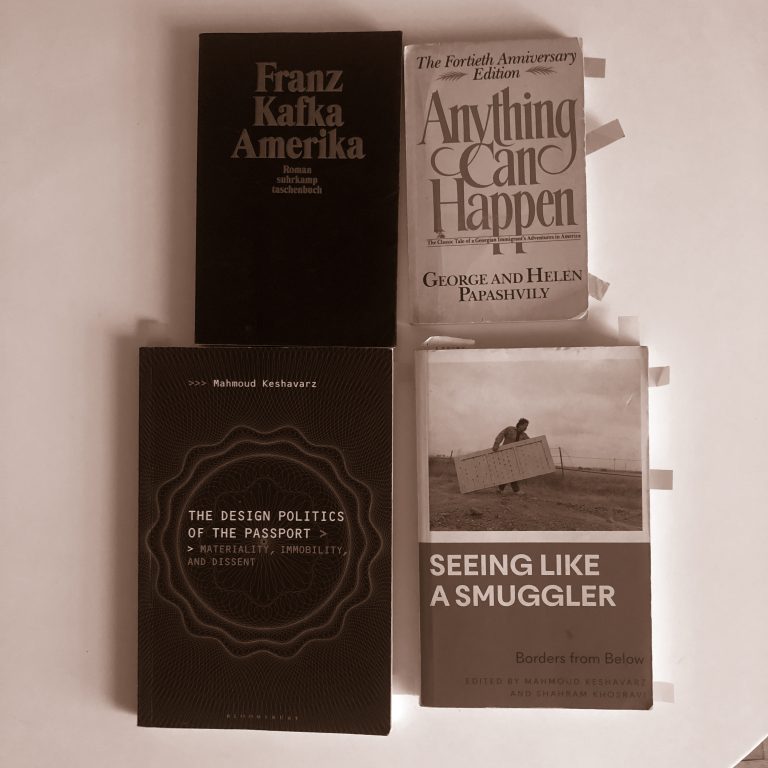
Anything Can Happen by George and Helen Papashvily, 1945
My copy is full of marked passages I often return to when browsing my bookshelf. It recounts Papashvily’s experiences as a newly arrived immigrant in America, working odd jobs, trying food and flavors foreign to him. It is written mainly in broken English mirroring his own struggle with the language. Funny and absurd.
There is always Kafka for me.
Two publications by Mahmoud Keshavarz form part of my research and are central, among other sources, to my current work cycle: Seeing Like a Smuggler: Borders from Below which traces the movement of people and goods across borders— from Afghanistan to Zimbabwe, Singapore to Guatemala, and beyond. It explores how people navigate inequality and restrictions on mobility, and attests to how clandestine activities can fuel creative forces. The Design Politics of the Passport takes the passport as a focal point to examine how design is entangled with political power and the control of movement. Through personal stories and theoretical reflection, Keshavarz demonstrates how design can also be used to contest the very systems in which it operates.
Viola Yeşiltaç is a German artist of Turkish descent, who lives and works in Cologne, Germany, and Brooklyn, NY.
Yeşiltaç’s practice considers a range of socio-cultural issues, such as migration, through the lens of her personal history. She reflects intensively on the idiosyncrasies of places in her conceptually-driven works, which she does in a diverse range of media.
Recent solo exhibitions include: Kunstverein Springhornhof, Neuenkirchen, Germany (2023), Kunst an Kölner Litfaßsäulen, Germany (2022), Kunsthaus Rhenania, Cologne, Germany (2020), Fondazione Brodbeck, Catania, Italy (2018)
Yeşiltaç has also participated in numerous group exhibitions, including Bureau Gallery, New York (2023), Kunstverein Langenhagen (2022), the Museum of Contemporary Art, Detroit (2017), Modern Art Oxford, UK (2016), Extra City Kunsthal, Antwerp (2015), The Kitchen, NYC (2015) and the 30th São Paulo Biennale (2014) among others.
Please note the views published in What I am Reading Now… are personal reflections of the contributors.
These may not necessarily represent the views of the University of Dundee.
———
Previous Issue: Titilayo Farukuoye, November 2025
Next Issue: Alia Syed, January 2026
