What I am Reading Now…
Gilane Tawadros
November 2026
‘The author has not given his effort here the benefit of knowing whether it is history, autobiography, gazetteer, tragedy, romance, almanac, melodrama, or fantasy. It may be myriad, it may not. The question is put, but where is the answer.’ Richard Flanagan’s Question 7 is prefaced by a quote from the Hobart Town Mercury’s review of Moby-Dick in 1851. I have just finished reading it for the second time. Almost as soon as I reached the last page, I began re-reading it for a third time. It’s impossible to categorise Flanagan’s latest book. The Hobart Town Mercury review could be a description of Question 7. It is a beautifully-crafted, thought-provoking and generous book that ranges across memories of growing up in rural Tasmania, H.G. Wells’ love-life, the scientific discoveries that would lead to the dropping of the atom bomb on Hiroshima through to the barest glimpses of his father’s experience as a slave labourer in a Japanese prison camp. The mysterious question 7 of the title comes from an archetypal Chekhov story written in just two sentences which poses the question: ‘who loves longer, a man or a woman?’ As Flanagan explains, for Chekhov, the role of literature was not to provide answers but to ask the necessary questions. ‘Life is always happening and has happened and will happen,’ writes Flanagan, ‘and the only writing that can have any worth confounds time and stands outside of it, swims with it and flies with it and dives deep within it, seeking the answer to one insistent question: who loves longer?’
Like Question 7, Benjamin P. Davies’ Another Humanity asks what it means to be human. Turning to the philosophers and writers W.E.B. Du Bois, Édouard Glissant, Sylvia Wynter, Edward Said and Hannah Arendt, Davies’ thoughtful enquiry considers ‘how we might together re-construct, perform and defend a truly universal sense of humanity, another humanity, one that responds to, and lead us beyond, our time of universal crisis.’ In very different ways, both Flanagan and Davies confront head on the difficult and disturbing times we’re living through, ‘our time of universal crisis’, making connections between different events and moments in history that reveal starkly our shared humanity.
Pankaj Mishra’s The World After Gaza is also a reckoning with the current crisis and the fundamental moral questions posed by Israel’s war on Gaza. The book calls for what Hannah Arendt described as a necessary ‘process of mutual understanding and progressing self-clarification on a gigantic scale.’ For Mishra, this involves taking the ‘war in the Middle East and the bitterly polarized reaction to it… as the starting point for a broad re-evaluation of two competing narratives of the last century: the West’s triumphant account of victory over Nazi and communist totalitarianism, and the spread of liberal capitalism, and the global majority’s frequently thwarted vision of racial equality’. Citing the work of Jewish intellectuals Jean Améry and Primo Levi, Mishra’s book also poses a question about the role of the intellectual at a time of crisis. Conscious of how intellectuals ‘always and everywhere [have] been totally under the sway of power’ and with no guarantee of being heard or listened to, Améry nonetheless insists, as Mishra does, on ‘blindly [throwing] my word on the scale, whatever it may weigh.’
Priyamvada Gopal’s Insurgent Empires is a masterly account of liberation struggles against the British empire that not only centres the revolutionary, dissenting figures in India, Jamaica, Egypt and elsewhere that fought for and ultimately secured freedom from British colonial rule but also re-frames the history of anti-colonial resistance as one which had intimate connections and reverberations in the British metropole itself. Gopal maps the relationship between British critics of empire and the great movements of resistance to British rule which emerged across colonial contexts, arguing that “the emergence of metropolitan dissent on colonial questions alongside liberation struggles in the colonies…was a dialogical and, at times, dialectical process in which the lines of influence can be seen to go in both directions.” Our entangled histories and struggles are intimately related.
I’ve always been fascinated by how fictional texts can interrogate and illuminate our lives as powerfully as historical or theoretical texts. Chimamanda Ngozi Adichie’s exquisite novel Dream Count interweaves the inter-connected stories of four African women, their loves, longings and desires. ‘The point of art,’ writes Adichie in her author’s note, ‘is to look at our world and be moved by it, and then engage in a series of attempts at clearly seeing that world, interpreting it, questioning it…It cannot be a gimmick, it must at some level be true. Only then can we reach reflection, illumination and finally, hopefully, epiphany.’
© Gilane Tawadros, 2026.
Gilane Tawadros is Director of the Whitechapel Gallery, London. She was the founding Director of the Institute of International Visual Arts (Iniva) in London, chaired by Professor Stuart Hall, which, over a decade, achieved an international reputation as a ground-breaking cultural agency at the leading edge of artistic and cultural debates nationally and internationally. She has written extensively on contemporary art and curated a number of international exhibitions. She has worked with and advised a number of leading international cultural organisations including Tate, Hayward Gallery, Camden Arts Centre, International Foundation Manifesta, Venice Biennial and Forum for African Arts. She was a founding Trustee and Chair of the Stuart Hall Foundation. Recent publications include The Sphinx Contemplating Napoleon: Global Perspectives on Contemporary Art and Difference (Bloomsbury, 2021) and Stuart Hall: Detour to the Imaginary: Selected Writings on Visual Arts and Culture (Duke University Press, 2024). In 2024, she was awarded an honorary doctorate by the University of Sussex for her contribution to the visual arts.
Reading
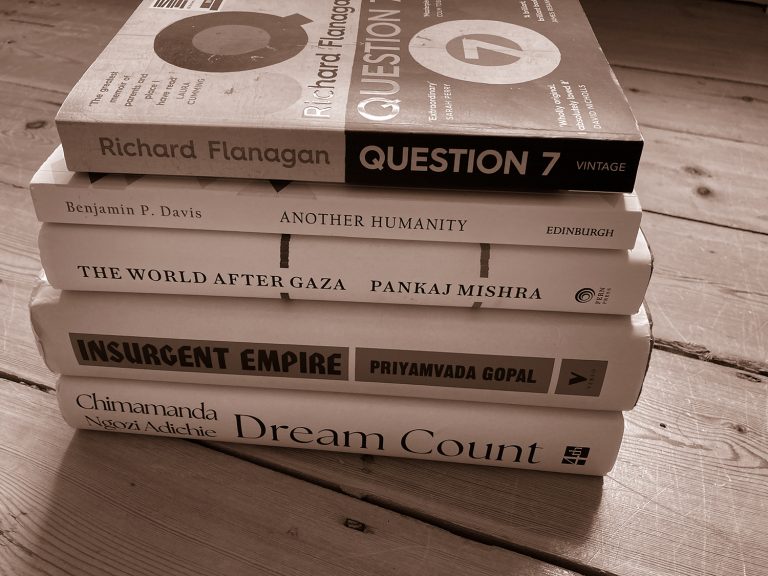
Question 7, Richard Flanagan (Vintage Digital, 2024)
Another Humanity: Decolonial Ethics from Du Bois to Arendt, Benjamin P. Davies (Edinburgh University Press, 2025)
The World After Gaza, Pankaj Mishra (Vintage, 2026)
Insurgent Empires: Anticolonial Resistance and British Dissent, Priyamvada Gopal (Verso, 2020)
Dream Count, Chimamanda Ngozi Adichie (Fourth Estate, 2026)
Please note the views published in What I am Reading Now… are personal reflections of the contributors.
These may not necessarily represent the views of the University of Dundee.
———
