What I am Reading Now…
Charles Tonderai Mudede
May 2026
I want to begin with this description of waking by the mid-century American poet Sylvia Plath: ‘…the no-color void / Where the waking head rubbishes out the draggled lot / Of sulfurous dreamscapes and obscure lunar conundrums’ (The Ghost’s Leavetaking, 1958). Something like this happens to me every morning. Without fail. The transition from the fantastic to the real, from the vaporous to the material, from the ‘lost otherworld’ to ‘the ready-made creation/ Of chairs and bureaus and sleep-twisted sheets.’ And during this groggy transition, I find not only myself (who, despite being the subject of all my dreams, is always weirdly or inexplicably absent from them) but myself in a world.
But what kind of world is this? Where and what do I call ‘the real’ and not ‘the dream’?
Moments after waking, after a cup of coffee, after a cigarette in the brightening morning light, I return to bed and begin reading a book. This habit, which consumes about a quarter of my waking hours, was established 30 years ago and to this day concerns making sense of another awakening: that of my whole life.
While leaving a dream, I ask myself: Who am I and Where am I? When this is determined, I must ask the deeper and lifelong question: What kind of world is this I find myself in? And why does it call me black? Why does it call those people white? Why does it make me work for a living? Why does it make money the measure of all things? What is money? Why this house? Why are others living on the street? Why am I a man? Why are they a woman? Where is God in all of this? Do ghosts exist? Why are angels essentially different from spirits? What makes a city tick?
The waking questions (who am I?; where am I?) are resolved in mere seconds, thank God. The living ones will take lord knows how long to resolve. And is there even a god? And is the second law of thermodynamics truly sure? For me, the waking hours require reading book after book after book–as this form of social transmission of information provides, as best as I can tell, the best steps to what can only be (and I might be wrong about this) a general understanding of this much larger and deeper picture.
Yes, the transition from dreams to the real automatically assembles the self; but that from awareness to a social and existential experience demands the accumulation of ideas expressed in books of all kinds. This is why I read. This is the whole function, purpose of the last five books I read, of the 4000 or so books I have read since the end of the 90s: To wake up to the world not in dreams but the one you and I share.
—
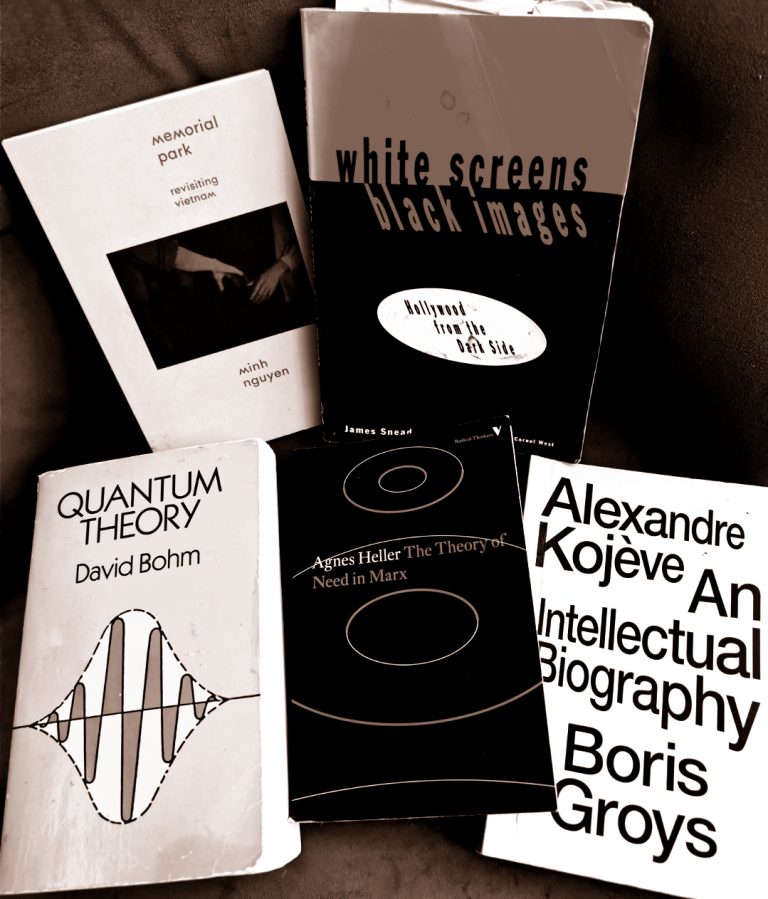
‘Marking is necessary because the reality of blackness or of being ‘colored’ cannot always, either in films or in real life, be determined. The racial terms ‘black’ and ‘white’ refer to a wide range of hues that cannot be positively described-by being this or that-but only by negative contrast: black is not ‘white’ (where ‘white’ itself is a term difficult to fix).’
—White Screens/Black Images: Hollywood from the Dark Side by James Snead
‘Here it becomes clear why Kojève prefers communist society, which he believes to be a society of self-awareness and self-reflection, to bourgeois consumerist society, which has only two answers to all questions: ‘I like it’ or ‘I do not like’’
—Alexandre Kojève: An Intellectual Biography by Boris Groys
‘I’m stuck in Smart City, a futuristic luxury complex thirty minutes outside of Hanoi. The digital keypad to my studio has malfunctioned, and the door it governs seems to have forgotten it’s a door, effectively locking me inside.’
— Memorial Park: Revisiting Vietnam by Minh Nguyen
‘This is the meaning of the statement that at the quantum level of accuracy, the universe is an indivisible whole, which cannot correctly be regarded as made up of distinct parts.’
—Quantum Theory by David Bohm
‘So the ‘class interest’ cannot be the motive of a class struggle that goes beyond capitalist society: the true motive, free from fetishism, is represented by the ‘radical needs’ of the working class.’
—The Theory of Need in Marx by Ágnes Heller
Charles Tonderai Mudede is a Zimbabwean-born American cultural critic, filmmaker, college lecturer, and writer. He is the Senior Staff Writer of the Stranger, a lecturer at Cornish College of the Arts at Seattle University, and has collaborated with the director Robinson Devor on three films, two of which Police Beat and Zoo, premiered at Sundance, and one of which, Zoo, screened at Cannes, and the most recent of which, Suburban Fury, premiered at New York Film Festival. (Police Beat is now part of MOMA’s permanent collection.) Mudede, whose essays regularly appear in e-Flux and Tank Magazine, is also the director of Thin Skin (2023).
White Screens/Black Images: Hollywood from the Dark Side, James Snead (Routledge, 1994)
Alexandre Kojève: An Intellectual Biography, Boris Groys (Verso, 2025)
Memorial Park: Revisiting Vietnam, Minh Nguyen (Wendy’s Subway, 2025)
Quantum Theory, David Bohm (Dover publications, Inc. 1979)
Please note the views published in What I am Reading Now… are personal reflections of the contributors.
These may not necessarily represent the views of the University of Dundee.
———
Previous Issue: Shola von Reinhold, April 2026
Next Issue: Larry Achiampong, June 2026
