What I am Reading Now…
Bahar Noorizadeh
March 2026
I keep this short.
There’s little left to express with the means we have been served and have entertained as language.
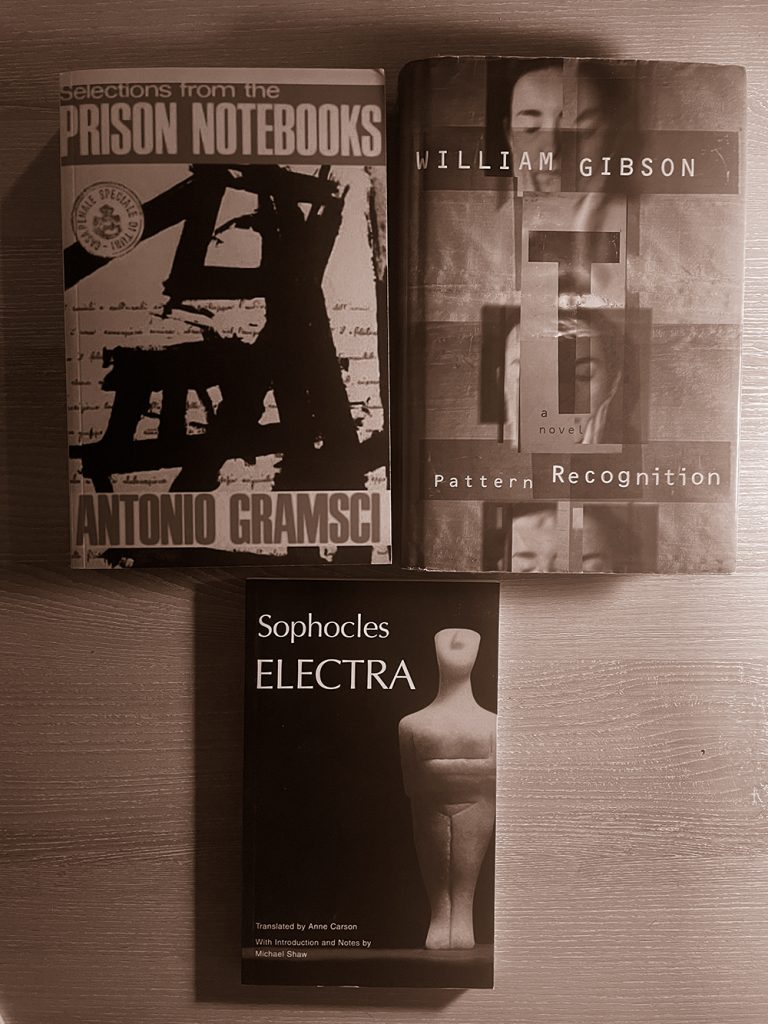
At times of catastrophe poets reject previous modes of sensemaking. “The old world is dying, and the new world struggles to be born: now is the time of monsters.” For Antonio Gramsci this was a struggle between the new and old generations at times of rising fascism. The time of monsters speaks the language of monsters in the interim before the new order sets in. The language I crave these days must come to par with the force of this viral contagion — and its sheer absurdity — devouring the planet. It must catapult me out of the numbness of the past years of terror and the mediocrity of liberal institutions (arguably at their deathbed, alas still resilient.) But also, it must stand to endure the abject content of our historical moment.
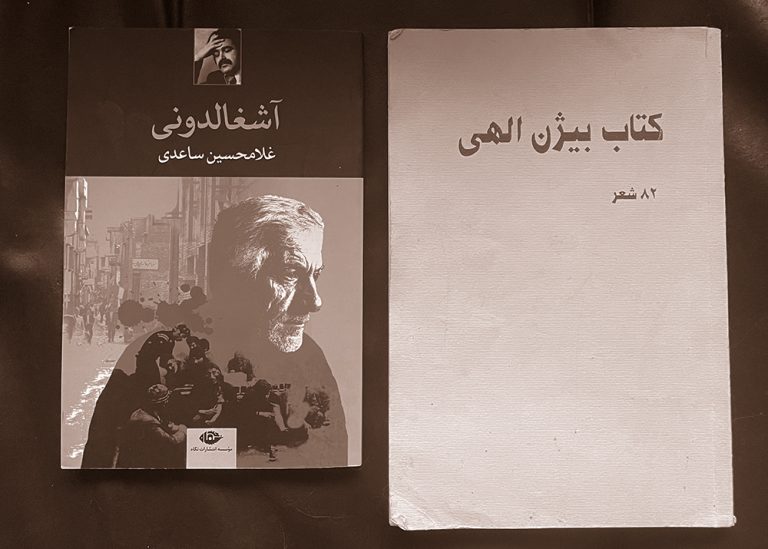
Gholamhossein Sa’edi’s Ashghaldouni (which translates to dump, though in Farsi has a significantly more appalling visceral sound to it) made me laugh for the first time in a while, a laughter that strikes one with humility, a reminder of the wretchedness of our human selves grounded in our collective affliction. Sa’edi’s tomb in Paris lately was desecrated (subjected to urine, more specifically) by the Iranian monarchists as penalty for his Marxist Communist affiliations.
The other work I find diagnostically apt at this moment is William Gibson’s Pattern Recognition. Prophetically, Gibson described the viral contagion of social media before the dawn of smart phone mandate. More and more we see how fascism works through schisms and fragmentation of our mediated worlds, worlds in which bombs may drop in our backyard or on our neighbours’ rooftops, yet we may cheer on our vitrined fantasies of escape, that venerable concept called freedom (yes, I am referring to the war in Iran right now.) It is in fact insane that a technological device meant to facilitate collective contact produced an immunological planetary shield, broken into insulated granular cognitions. I am in fact plotting a film to capture the insanity of this viral possession. At the same time, I find myself defending the Left to the disgruntled as a recovering disgruntled critique of the Left. I find myself defending the airy-fairyness of principles against technocratic TED-talk solutions to humanity’s future. What does it mean to rescale Saedi’s fleshy language, years before language became so cautious, so reserved, to the dimensions of the present? These are questions I’m invested in in my writing.
There will be generations before we recover, but if there is a silver lining to this longue durée, it is that we are finally relieved from the burden of our self-redemption: our very personal, customized teleology. We will not be redeemed, not so soon.
It is with this sense of relief that I step into study: the practice of shattering what’s remained of my ex-facto “sense” that is another name for poetry: Bijan Elahi’s poems these days for example, or Sophocles’s Electra, in the enchanting translation of Anne Carson.
Bahar Noorizadeh’s work looks at the relationship between art and capitalism, and their entangled moral, social and organisational technologies. In her practice as an artist, theorist and filmmaker, she examines the conflictual and contradictory notions of imagination and speculation as they collapse into one another. Her research investigates the histories and the futures of economics, from cybernetic socialism to neoliberal finance, and activist strategies against the financialization of life and the living space, asking what redistributive historical justice might look like for the present.
Noorizadeh is the founder and organiser of Weird Economies, a multi-authored platform dedicated to radical economic imaginaries. Her work has appeared at the Guggenheim Museum NYC (2024), Taipei Biennial (2023), Venice Architecture Biennial (2021), Transmediale Festival (2020, 2022), Tate Modern Artists’ Cinema Program (2018), and Geneva Biennale of Moving Images (2018) among others. She is the co-editor of the e-flux special issue on Iran (May 2024) and has contributed essays to e-flux Architecture, Journal of Visual Culture, and Sternberg Press, and anthologies by Duke University Press and MIT Press. Noorizadeh completed a PhD in Art at Goldsmiths, University of London and is currently teaching in MA Geo-Design at the Design Academy Eindhoven.
Noorizadeh’s exhibition The Debtor’s Portal runs until 11 April 2026 at Cooper Gallery, DJCAD, University of Dundee. Co-curated with The Otolith Collective.
كتاب بيژن الهى، ٨٢ شعر , Bijan Elahi (2013)
Pattern Recognition, William Gibson (G.P. Putnam’s Sons, 2003)
Selections from the Prison Notebooks, Antonio Gramsci (eds. & trans. Quintin Hoare and Geoffrey Lowell Smith) (International Publishers Co, 1971)
آشغالدونى , Gholamhossein Saedi (1995)
Electra, Sophocles, c. 420-414BC (trans. Anne Carson) (Oxford University Press, 2001)
Please note the views published in What I am Reading Now… are personal reflections of the contributors.
These may not necessarily represent the views of the University of Dundee.
———
Previous Issue: Ibrahim Nehme, February 2026
Next Issue: Shola von Reinhold, April 2026
