What I am Reading Now…
Ibrahim Nehme
February 2026
Lately, I’ve been thinking of reading not as a private act but as a practice of apprenticeship. Apprenticeship to those who came before us, to those who walk beside us, and to the versions of ourselves we are still becoming. The five works gathered here are not just “books I am reading now,” but five currents shaping the thinking, sensing, and imagining that are carrying me through this particular season of my life.
I return to Etel Adnan often, but these days it is Letters to Fawwaz that sits open on my desk. There is something in the economy of her phrasing, the way she dissolves the distance between the intimate and the cosmic, that reminds me that correspondence is a form of world-making. In these letters, Etel writes as though light could be folded, as though time could be held in the hand like a stone. I read her to remember that thought can be tender and searing at once, and that language, when freed from the burden of explanation, becomes a form of breathing.
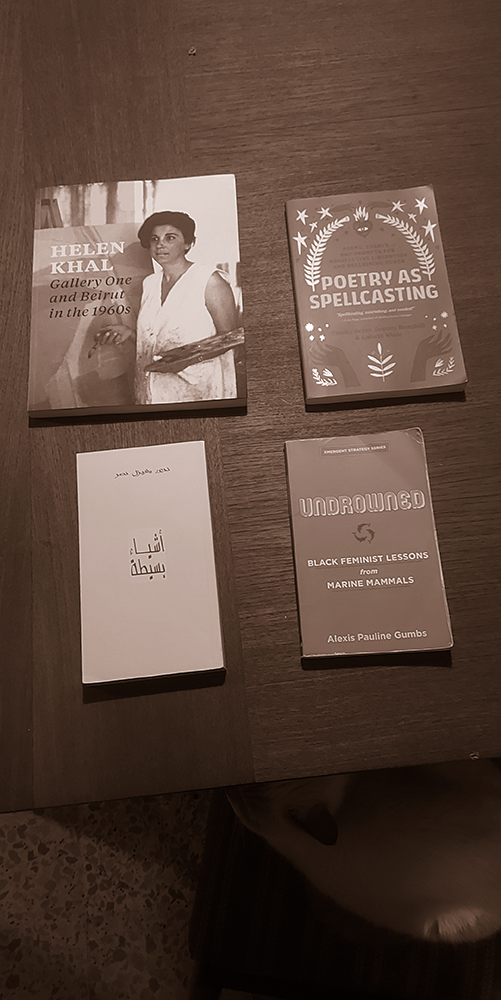
From Adnan’s elemental clarity I move to the charged terrain of Poetry as Spellcasting, an anthology that treats poetry as a living technology, a magic we perform with and for each other. I am pulled toward this book because it mirrors something I have come to believe: that imagination is not a luxury but a method of survival. These essays and incantations remind me that the future needs rituals, and that art is one of the rituals we have. In a time when the world feels increasingly scripted by collapse, this book insists on the possibility of collective enchantment, on language as an instrument of repair.
A companion to this is Alexis Pauline Gumbs’, Undrowned, a book I read slowly, like a tide that teaches you how to listen. Gumbs looks to marine mammals for Black feminist lessons in endurance, adaptation, and breath. What she offers is not just metaphor but method: a practice of staying present in the water of our lives without being dragged under. As someone who has always turned to the sea for clarity, I read Undrowned as a reminder that buoyancy is a skill, which we learn and relearn each time a wave feels too large to rise above.
Closer to home, I have been reading Nada Moghaizel’s Ashyā’ basīṭa (Simple Things), a collection that honours the small gestures that hold a life together. In these fragments there is an honesty that refuses spectacle, a beauty rooted in the ordinary. Receiving this book as a gift felt like inheriting gentle wisdom, a reminder that the simplest acts of care and attention are sometimes the most radical. Nada’s writing hums with the subtle electricity of the everyday, and reading her has softened something in me, returned me to the scale of the hand, the room, the breath.
Finally, I have been spending time with the Helen Khal monograph, an excavation of Beirut’s artistic life in the 1960s. Beyond its art-historical importance, the book offers a window into the atmosphere from which the Shi’ir movement emerged, a movement that has long fascinated me for its audacity, its refusal of inherited forms, its insistence on the poem as a portal. Reading these archival traces feels, in a way, like entering the backstage of a city’s imagination. It reminds me that Beirut has always been a laboratory of difficult beauty, a place where artists and poets rehearsed new futures long before they could be lived.
Together, these readings form a constellation of breath, ritual, lineage, and risk. They are the texts helping me practice the future. Slowly, stubbornly, with as much clarity and tenderness as I can bear.
Ibrahim Nehme is a writer, editor, and cultural organizer based in Beirut. He is the Director of Beirut Art Center and the founding editor of The Outpost magazine. His work moves between curating, publishing, and collective imagination, exploring how art can open portals toward more livable futures. Across his projects, he is committed to practices of creativity, care, and community-building that nurture new possibilities for cultural life.
Please note the views published in What I am Reading Now… are personal reflections of the contributors.
These may not necessarily represent the views of the University of Dundee.
———
Previous Issue: Alia Syed, January 2026
Next Issue: Bahar Noorizadeh, March 2026
