
1 – Executive Summary
In this paper we present an analysis of the financial forecasts produced by the UoD Finance team in October 2025 and February 2026, challenge the reliability of the data and assumptions they were based upon, and present an alternative financial forecasting model that shows that the University of Dundee is already on its way to recovery and further staff reductions are completely unjustified.
Highlights:
- The financial forecasting reported in the University Recovery Plan (URP) submitted to the SFC in August 2025 failed to account for the savings realised from staff leaving through retirement, resignation, etc. (~250 FTE) in the previous year.
- Given the 500 FTE staff lost between Aug 2024 and Oct 2025, the University should already be on par with the URP, contradicting the Interim Director of Finance’s (IDoF) forecast.
- DUCU estimates that an additional 65 FTE staff have left since Oct 2025.
- Even if the uptake on the most recent VS scheme was to be low, at least ~150 FTE will have left by Apr 2026.
- Modelling these numbers – which constitute a conservative estimate – shows that the University should already be on a trajectory to achieve cash reserves of £60-80m by mid-2030. This is the case even without accounting for any profit-increasing initiatives.
2 – Background
In this paper we analyse the financial information and staffing data at the University of Dundee. As the University seeks to recover from continuing financial and governance crisis, it is imperative that stakeholders, including staff and students, should have access to up-to-date financial data. This allows us to reach our own our conclusions on the current and future direction of the University, and whether the route to financial stability through staff cuts, outlined by UEG and approved by Court, will be effective in creating a sustainable organisation.
In the absence of up-to-date data being made available to staff and unions, we have used sources of data from information on the University’s financial position shared by the Interim Director of Finance in two presentations in October 2025 and February 2026; in Townhall and Principal Questions events; information shared with the Scottish Parliament’s Education, Children and Young People’s Committee (ECYPC); The Gillies report and other accounting reports produced at the request of the University in 2025; and previous University of Dundee Financial Statements.
3 – Scrutiny of UEG Financial predictions
3.1 Staff Costs & EBIDTA
In November 2024, the University of Dundee reported a £30-35m structural deficit. At the time, the University reported to employ 3,259 FTE staff and to have incurred £184m in staff costs. However, in the 13 November 2025 letter to the ECYPC, the University of Dundee disclosed that in August 2024 UoD employed only 3,092 FTE (Table 1). This discrepancy demonstrates that data on staff numbers at the University of Dundee continues to be opaque and could potentially misinform strategic decisions on staffing levels.
Using only the figures from the correspondence to the ECYP in November last year (2025), the University has lost 489 FTE between August 2024 and October 2025. Included in this number are the 240 FTE who left during the Voluntary Severance scheme in Autumn 2025. We estimate that approximately 65 FTE staff have left since October 2025, and 145-150 FTE staff will leave the University through the current VS scheme, culminating in a total loss of ~700 FTE staff, i.e. 22% of staff to date (Figure 1). The estimated remaining 2424 FTE staff is the lowest number of staff observed in at least the last 20 years at UoD.
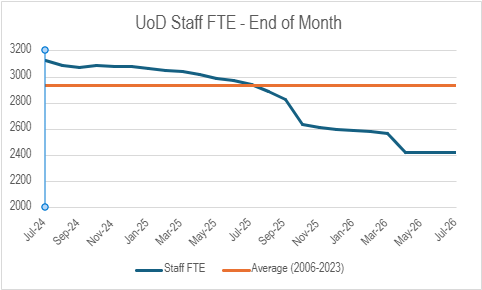
Figure 1. UoD Staff FTE AJul 24 – Jun 26. Apr-Jun 26 are estimates on the basis of target staff reductions proposed in the latest VS scheme that opened in Feb 2026.
Based on the above staff data, DUCU estimated that once the FTE target of the second VS scheme is met UoD will see a reduction in staff costs of ~£40m per year compared to what the Interim Director of Finance’s (IDoF) reported for 2024/25 (Table 1), thus fully addressing the operating deficit through staff costs reduction only and rendering any further reductions in staffing levels unnecessary.
Table 1. Estimated staff costs based on staff reductions reported in UoD letter to ECYPC of 13 November 2025 and following the second Voluntary Severance (VS) scheme that opened in Feb 2026. These predictions do not include any further staff reductions through Compulsory Redundancy (CR).
| Source | Staff Costs (£m) | %Cost Change YoY | Staff FTE (EoY/Average) | Staff cost savings (£m) | |
| 2024/25 | UoD | 189.1 | 2.7% | 3,092 | – |
| 2024/25 | DUCU estimate | 176.9 | -3.9% | 3,041 | 11.8 |
| 2025/26 (2VS, no CR) | DUCU estimate | 155.6 | -12.1% | 2,586 | 25.8 |
| 2026/27 (2VS, no CR) | DUCU estimate | 150.5 | -3.3% | 2,420 | 9.0 |
As a result, DUCU estimates much more favourable EBIDTA than what is being currently predicted by the IDoF (Table 2).
Table 2. Estimated EBIDTA based on staff costs predictions reported in Table 1 and UoD data on income and assuming operating costs are increasing year-on-year. These predictions do not include any further staff reductions through Compulsory Redundancy (CR).
| Source | Income (excl. SFC) | Staff Costs (£m) | Operating Costs (£m) | %EBIDTA | |
| 2025/26 | UoD | 310.4 | 176.4 | 120.5 | -5% |
| 2025/26 (without VS costs) | DUCU estimate | 296.8 | 155.6 | 111.1 | 10.1% |
| 2025/26 (with VS costs) | DUCU estimate | 296.8 | 155.5 | 127.5 | 4.6% |
| 2026/27 | DUCU estimate | 296.8 | 150.5 | 131 | 5% |
3.2 Pessimistic cash projections
The IDoF has been consistently and, in our view, unjustifiably pessimistic on the cash projections he has shared with staff and the SFC (Figure 2).
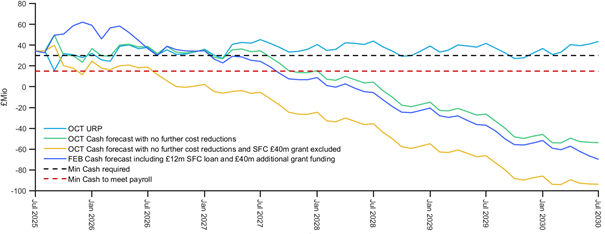
Figure 2. Cashflow predictions as reported in the University Recovery Plan (URP) submitted to SFC in August 2025 (OCT URP), as presented to staff by the IDoF in October 2025 (OCT Cash forecast with no further cost reductions & OCT Cash forecast with no further cost reductions and SFC £40m grant excluded) and in February 2026 (FEB Cash forecast including £12m SFC loan and £40m additional grant funding).
- The University Recovery Plan produced in August 2025 and disclosed to staff at the end of Sept 2025 predicted a cash balance at the end of September 2025 of less than £20m (OCT URP). However, the actual cash held by the University in Sept 2025 was ~£50m (dark blue and green lines). Even subtracting the £10m received from the SFC as an advance on the yearly SFC funding, the difference between the predicted and actual cash held by UoD as of Sept 2025 is more than £20m.
- The cash decline predicted in the Oct Cash forecast with or without the additional SFC £40m grant (green and yellow lines) never materialised (see FEB Cash forecast – dark blue line – presenting the actual cash held by UoD between Sept 2025 and Feb 2026).
- Despite the loss of 489 FTE between July 2024 and October 2025, the cash forecasts presented to staff by the IDoF in Feb 2026 (FEB Cash forecasts – dark blue line) suggest that the University is running out of money quicker than if no additional staff reductions had been made since Oct 2025 (green line). In fact, the IDoF February forecasts (dark blue line) suggest that the University’s cash will reach below the minimum cash level to meet payroll 2-3 months earlier than if no further staff reductions had been enacted (green line).
- According to the IDoF, the light blue line (OCT URP) shows the outcome of 690 FTE staff reductions, as presented in the August URP. However, after losing 489 FTE staff and an additional 150-200 FTE being expected to leave through the current (Mar 2026) VS scheme, the University is still predicting to run out of cash in the next couple of years.
These pessimistic projections have been used as a foundation of multiple narratives by the UEG predicting variously that:
- the University is imminently running out of cash, originally purported as Sept/Oct 2025, now updated to Sept/Oct 2026.
- the University is spending more than its income.
4 – DUCU Financial modelling
The cash flow forecasts presented by the IDoF to all staff can be broken down into three subsets of identical, annually repeating patterns arranged to model a declining linear trend, as shown below (Figure 3).
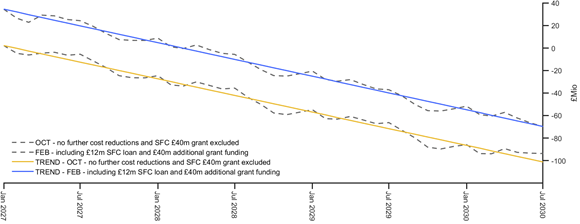
Figure 3. Cashflow predictions as presented to staff by the IDoF in October 2025 (OCT) and February 2026 (FEB) and corresponding downward trends (blue and yellow lines).
If the declining trends are removed numerically, the forecasts are virtually identical, even when compared with the URP submitted in August (Figure 4, light blue trace):
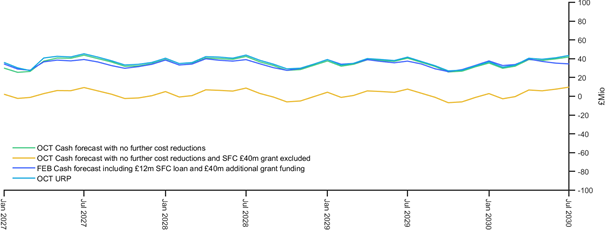
Figure 4. Cashflow predictions as reported in the URP submitted to SFC in August 2025 (OCT URP), as presented to staff by the IDoF in October 2025 (OCT Cash forecast with no further cost reductions & OCT Cash forecast with no further cost reductions and SFC £40m grant excluded) and in February 2026 (FEB Cash forecast including £12m SFC loan and £40m additional grant funding) without downward trends.
This evidence suggests that any “modelling” done from Jan 2027 onwards can simply be explained by the added trend of a linear cash decrease, e.g. a pre-defined operating deficit entered as a constant number every year. Absent any justification, this way of financial forecasting seems over-simplistic at best.
Adopting the same “modelling” strategy, DUCU plotted the expected cashflow that would derive from accounting for the actual number of FTE staff that has left the University as of Oct 2025 (~500 FTE), and after the closure of the latest VS severance launched in Feb 2026 (~650 FTE as a conservative estimate) (Figure 5).
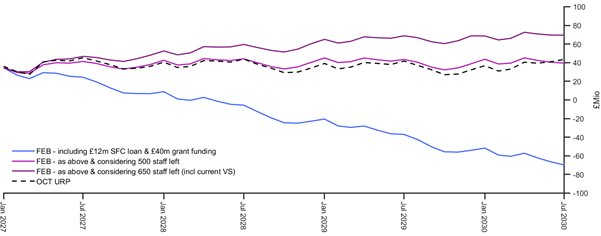
Figure 5. Cashflow predictions as presented to staff by the IDoF in October 2025 (OCT URP) and February 2026 (FEB – including £12m SFC loan and £40m grant funding) compared to DUCU cashflow predictions accounting for the loss of 500 FTE (FEB – as above & considering 500 staff left) or 650 FTE (FEB – as above & considering 650 staff left).
These predictions assume that 500 FTE staff cost the University ~£30-35m per year – an estimate made on the basis that a 240 FTE staff reduction through VS saved the University ~£15m – and include a drop in savings of £2m per year due to inflation, salary increments etc. The difference in outcome is stark:
- Accounting for all the 500 FTE lost by Oct 2025 shows that the University’s cash is already on par with the University Recovery Plan (URP), directly contradicting the IDoF’s forecast.
- Adding to the 500 FTE already lost the ~150 FTE that are predicted to leave by Apr 2026 puts the University on a trajectory to achieve a cash surplus of £60-80m by mid-2030. This prediction does not account for any income-generating activity put forward before 2030.
5 – Conclusion
UEG and the IDoF have presented a pessimistic narrative of an institution in decline as financial evidence for their argument to staff, students, and the SFC that the only way for the University to “survive and recover” is to reduce the workforce to the point that the University’s income is more than its spending. However, this argument is flawed as:
- It is based on unjustifiably pessimistic projections of income and cashflow, as shown above.
- It assumes that a reduction in workforce won’t impact income or the delivery of income-generating activities.
- It doesn’t account for the fact that the reduction in core staff will mainly come from income-generating areas that are also teaching-intensive and that create sustainable and low-cost sources of income for the university.
- It doesn’t address the longstanding issue of structural imbalance within the university between resource-intensive research activities with high overheads that are subsidised by teaching income.
- It doesn’t take into account that the University is already at historically low staffing levels (lowest in the past 20 years), even before considering the current VS scheme.
DUCU believes that unreliable staff data and questionable assumptions have been relied upon to predict staff costs, EBITDA, and cashflow levels. According to our predictions, UoD should be already on the path to recovery.
In conclusion, there are no justifications for further staff reductions, whether through voluntary or compulsory means.
6 – References
- University of Dundee Correspondence with ECYPC of 13 Nov 2025
- Financial Update to UoD Staff – 23 October 2025
- Financial Update to UoD Staff – 17 February 2026