
We are excited to host Thermomorphogenesis 2026 from 26 to 28 August 2026 at the University of Dundee! This in-person meeting brings together scientists working on acclimation responses to (elevated) ambient temperatures and serves as a platform for presenting cutting-edge research – much of it unpublished – fostering discussion of recent advances and facilitating new collaborations. The scientific programme will cover a wide range of topics related to temperature-controlled plant biology, including (but not limited to):
- Developmental processes triggered by elevated ambient temperature
- Spatial and temporal aspects of temperature responses
- Interplay between thermomorphogenesis and heat stress responses
- Temperature sensing mechanisms in plants
- Signalling cascades in response to elevated temperature (including transcriptional, post-transcriptional, and post-translational regulation)
- Interactions between temperature-controlled development and metabolism
- Integration of temperature signals with other environmental cues
- Thermomorphogenesis in the context of climate adaptation
- Temperature responses in crop species
- Harnessing temperature signalling pathways to enhance crop resilience
Registration
As with previous instalments of this meeting, Thermomorphogenesis 2026 is completely free to attend. To gauge attendance and plan the programme accordingly, we ask you to register for the meeting by 31 May 2026 following this link. Please note that the meeting will be capped at 80 participants. We are also offering two types of slots for presentations: full talks (15 minute presentation followed by 5 minutes of questions) and flash talks (5 minutes, no questions); the latter are particularly suited for researchers at the beginning of their (thermomorphogenesis) research journey, who do not yet have many data to present but still would like to showcase their project. We hope that we can give anyone who is keen to present the opportunity to do so, but this will depend on the number of attendees.
Programme
You can access the tentative programme below. Please note the programme has not been finalised and is subject to change until the start of the conference.
Travel Grants
We are able to offer three travel grants (£500 each) to support attendance at Thermomorphogenesis 2026. These grants are intended for early career researchers (students and postdoctoral researchers) and the awardees will be required to present a full or flash talk at the meeting.
To apply, please submit a short statement (maximum 200 words) outlining why you would benefit from attending the meeting and why you should be considered for a travel grant. Priority will be given to applicants based at institutions/in countries where access to travel funding is limited.
Please send your application to mbalcerowicz001@dundee.ac.uk by 30 April 2026. Successful applicants will be notified shortly thereafter.
Map
Venue
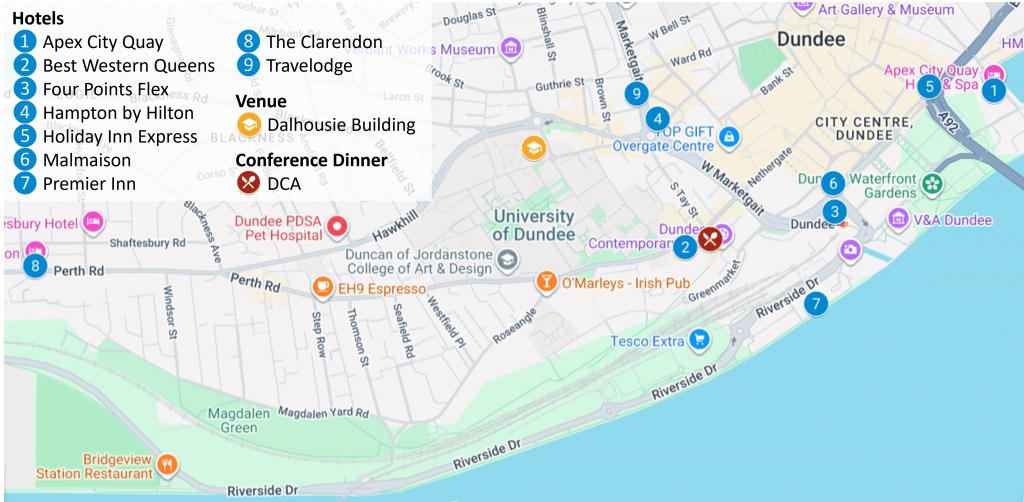
The meeting will take place at the University of Dundee, which is located on the sunny east coast of Scotland, right on the banks of the River Tay. The conference will be held within Dalhousie Building, Old Hawkhill, Dundee DD1 5EN.
Accommodation
Dundee harbours a number of centrally located and affordable hotels within walking distance to the University. You can find a non-exhaustive list of budget-friendly hotels (2-3 stars) below:
- Best Western Queens Dundee Hotel
- Four Points Flex by Sheraton Dundee
- Hampton by Hilton Dundee City Centre
- Holiday Inn Express Dundee
- Premier Inn Dundee City Centre
- Travelodge Dundee Central
More high-end options (4 stars) are also available:
Conference dinner
We are getting together for a self-paid conference dinner on Thursday evening (27 August) at Jute Café Bar within the Dundee Contemporary Arts (DCA) Centre, 152 Nethergate, Dundee DD1 4DY. Exact time to be confirmed. Please indicate whether you are planning to join during registration. Changes can be made up a week prior to the conference.
Getting to Dundee
From abroad: Edinburgh (EDI) or Glasgow (GLA) airports are your best options. From Edinburgh Airport, a short ride on the Edinburgh Tram gets you to Edinburgh Gateway train station, which provides direct train connections to Dundee (~75 minutes). Alternatively, you can take a FLY or Ember coach directly from Edinburgh Airport to Dundee (80-90 minutes). From Glasgow Airport, either catch the Airport Express 500 to Glasgow Queen Street train station, which offers train services to Dundee, or take a direct Flixbus coach (both journeys take approximately 2 hours).
From within the UK: Dundee Airport (DND) is an option for anyone travelling from London as Loganair offers direct flights from Heathrow. Alternatively, LNER offers direct train connections to Dundee Railway Station from London King’s Cross (via York and Newcastle) and Cross Country offers one direct service per day from Plymouth (via Exeter, Bristol, Sheffield and Leeds). Many more options are available with a single change.
Getting around: Dundee’s city centre is quite walkable. If required, local bus services are operated by Stagecoach East Scotland and Xplore Dundee; tickets can be purchased directly from the driver.
What to do in and around Dundee
Located on Scotland’s east coast, Dundee combines a rich industrial heritage with a thriving contemporary arts scene and scenic surroundings along the River Tay.
Visitors interested in culture and design can explore the V&A Dundee, Scotland’s first design museum, located on the revitalised waterfront, right next to Discovery Point, where you can uncover the history of the Royal Research Ship Discovery and her legendary Antarctic expedition of 1901 under Captain Scott. Other excellent museums and galleries include The McManus: Dundee’s Art Gallery & Museum, which celebrates the region’s history, art and natural heritage, and Verdant Works, which showcases Dundee’s industrial heritage.
For those who prefer the outdoors, Dundee offers green spaces and coastal scenery. A walk along the waterfront or a short trip to Broughty Ferry provide beaches, a historic castle and views across the Tay. At the outskirts of the city, Camperdown Country Park offers woodland walks and wildlife.
Dundee is also an excellent base for exploring the surrounding region. Nearby St Andrews – easily reached by bus – offers historic streets, coastal walks and world-famous golf heritage. Close by, you find the recently established Eden Mills and Kingsbarns distilleries for a taste of local gin and whisky. The coast northeast of Dundee can also be explored by train, providing access to the ruins of Arbroath Abbey and the scenic Arbroath Cliffs.
For those travelling by car, the wider region offers further highlights, including Glamis Castle, one of Scotland’s most iconic historic houses, and the spectacular cliff-top fortress of Dunnottar Castle near Stonehaven. Visitors may also wish to explore parts of the Cairngorms such as Glen Clova for walking and scenic drives, or head further into the Highlands.
Sponsors
We are grateful for financial support from our sponsors: The Company of Biologists, the New Phytologist Foundation, the Royal Society, the Society of Experimental Biology (SEB), The Plant Journal and the Wellcome Trust.






Contact
If you have any questions about the conference not addressed above, please contact Martin directly at mbalcerowicz001@dundee.ac.uk.