
John’s Story
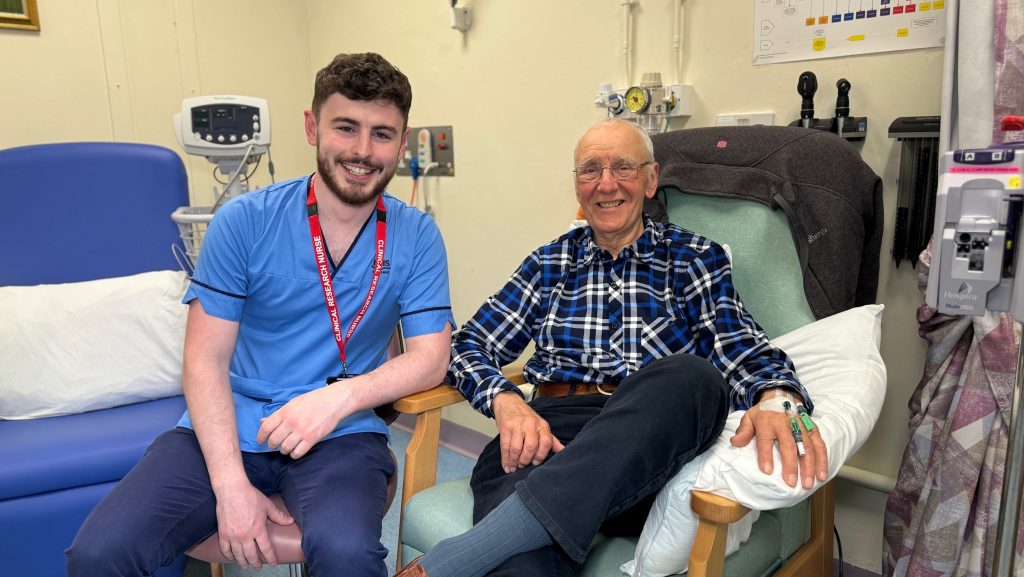
John, a retired schoolteacher from Kirriemuir, was diagnosed with stage 3 non-small cell lung cancer late in December 2023 after experiencing some abdominal pain. He started chemo-radiotherapy in March 2024 for 12 weeks. After this, John was offered the opportunity to participate in one of Ninewells clinical research trials for a new immunotherapy treatment protocol – the PACIFIC-9 trial. This trial is a Phase III, double-blind, placebo-controlled, randomised, international study that the University of Dundee and NHS Tayside are participating in which evaluates the efficacy and safety of combining Durvalumab – John’s standard treatment – with either Oleclumab or Monalizumab in patients with locally advanced (Stage III) non-small cell lung cancer (NSCLC) like John.
The trial involved a double-blind test which is a way for researchers to ensure the accuracy of their results. In such a test a proportion of the patients in a sample group are given the drug to be tested and the other are given a placebo (a fake treatment) – neither the researchers nor the patients know if they have received the actual treatment or a placebo. This is important because it prevents bias—If researchers knew who got the real treatment, they might treat those people differently or expect better results. Participants in the trial won’t act differently just because they think they got the real medicine. Because no one knew who got the real treatment, the results are more trustworthy, proving that the immunotherapy actually worked and wasn’t just a psychological effect. Patients in the Pacific-9 study therefore were treated with either Durvalumab plus Oleclumab, Durvalumab plus Monalizumab or Durvalumab plus a placebo.
John has not known throughout his treatment whether he received the placebo or not – but by participating in this trial he has helped the researchers check the efficacy of the immunotherapy. If the immunotherapy worked much better than the placebo, it will be approved for public use.
As a former chemistry teacher John marvels at the incredible advances in these therapies: “Being of interest to me I had a look at the chemical structures of the drugs I was receiving. One was a fairly simple molecule that can be synthesised in the lab. Another was a gigantic complicated molecule which had been extracted from a plant, and could never have been completely synthesised in the lab. What is amazing to me is the incredible research that must have gone into finding out about the properties of these chemicals in fighting cancer”.
John says: “The staff at the clinical trials centre at Ninewells have been absolutely brilliant. Despite the fact I’m in for my regular therapy, I actually enjoy seeing and chatting with them. It’s become like visiting friends”.
After his last CT scan John received the wonderful news from his consultant Dr Fay Tough that his cancer had gone.